FACTORY NETWORK BUSINESS CONFERENCE

International trade enables countries to exchange goods, services, and capital across borders, creating economic prosperity through specialization and market expansion. For businesses navigating global supply chains, understanding international trade fundamentals has become essential for competitive success. This article from FBC ASEAN explores what international trade really is, why it remains a critical driver of global economic growth
What is International Trade?
International trade is the exchange of goods, services, capital, and technology across national borders. It allows countries to specialize in producing what they make most efficiently while importing products that others produce better. International trade operates through multinational corporations managing global supply chains, SMEs accessing markets via e-commerce, and service providers facilitating cross-border transactions through logistics, financing and compliance support.
Core theories in International Trade
To understand the complexity of global exchange, it is essential to examine the fundamental economic frameworks that have shaped cross-border commerce for centuries. These core theories provide the rationale for why nations trade and how they maximize their economic welfare.
Absolute advantage theory
Adam Smith’s absolute advantage theory (1776) states that countries should produce and export goods they can manufacture more efficiently than others, while importing products where other nations hold production advantages.
- Example: Middle Eastern oil exports leverage abundant petroleum reserves, while Switzerland exports precision instruments using advanced manufacturing capabilities.
Comparative advantage theory
David Ricardo’s comparative advantage theory (1817) demonstrates that countries benefit from trade even without absolute advantages, provided they specialize in products where they have relative efficiency advantages.
- Real-world application: Bangladesh became the world’s second-largest clothing exporter ($47 billion annually) by focusing on labor intensive garments despite lacking absolute advantages in most manufacturing.
Resource factors
The Heckscher Ohlin model explains trade through resource endowments: countries export goods requiring intensive use of their abundant factors (land, labor, capital, technology) while importing products demanding scarce resources.
Vietnam’s trade perfectly illustrates comparative advantage: leveraging its favorable climate to be the world’s second-largest coffee exporter while importing sophisticated machinery to compensate for limited domestic capital goods production. This strategy allows Vietnam to optimize resources and drive economic growth.
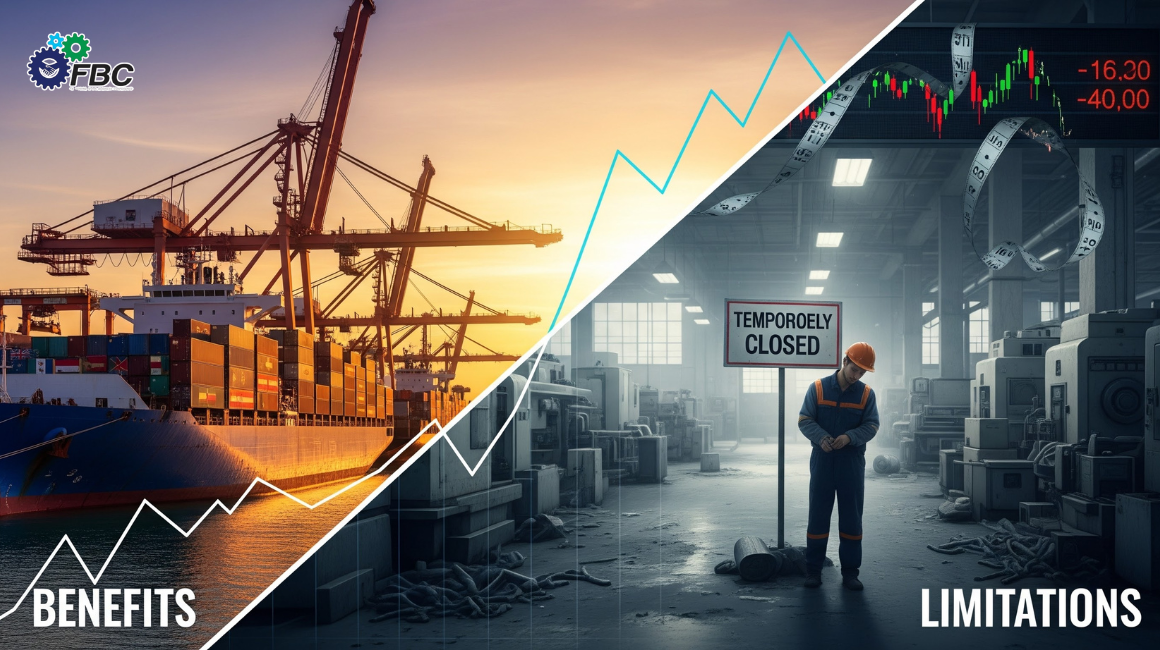
Benefits and limitations of International Trade in the current situation
In the complex global landscape of 2026, international trade is no longer just about economic efficiency, it has become a strategic tool intertwined with national security and digital transformation.
Superiority
The definition of superiority is currently undergoing a fundamental shift, moving away from low-cost production toward innovation driven excellence and sustainable manufacturing standards.
- Economic efficiency: Specialization increases global production by 25-40% compared to self sufficiency scenarios.
- Consumer benefits: Trade liberalization reduces prices 10-30% for imported goods while increasing product choices 40-60%.
- Technology transfer: Firms engaged in international trade show 30-50% higher productivity growth than domestic-only competitors.
- Employment: Vietnam’s export manufacturing employs 10+ million workers with wages 30-50% above agricultural incomes.
Limitations
However, the expansion of global commerce is not without its drawbacks. While it fosters growth, international trade also introduces significant limitations and risks that can destabilize domestic industries and exacerbate global inequalities.
- Job displacement: Rapid trade liberalization eliminates 2-5% of manufacturing jobs in import-competing sectors over 5-10 years.
- Income inequality: Returns favor capital owners and skilled workers while wages stagnate for less-educated workers facing import competition.
- Environmental impact: Global shipping contributes 3% of greenhouse gas emissions.
- Supply chain vulnerability: COVID-19 exposed risks of concentrated production locations.
Main components of International Trade
International trade is fundamentally structured around four main components: goods, services, capital flows and intellectual property, which together facilitate the global exchange of value.
Exports and imports
Beyond mere numbers, the structure of exports and imports reveals a nation’s position within the Global Value Chain (GVC) and its strategic economic priorities.
- Exports – Selling to the World
Vietnam’s exports reflect its industrialized growth, moving from raw materials to high-tech manufacturing. For example, electronics are a priority in the investment portfolio, specifically smartphones and semiconductor chips, largely supplied by major FDI corporations such as Samsung and Apple’s suppliers.
This sector has seen explosive growth, with electronics and computer components now accounting for over $113 billion in export value, representing a significant portion of the country’s total GDP. This transition underscores Vietnam’s evolving role as a key manufacturing hub in the global electronics supply chain.
- Imports – Buying for Production
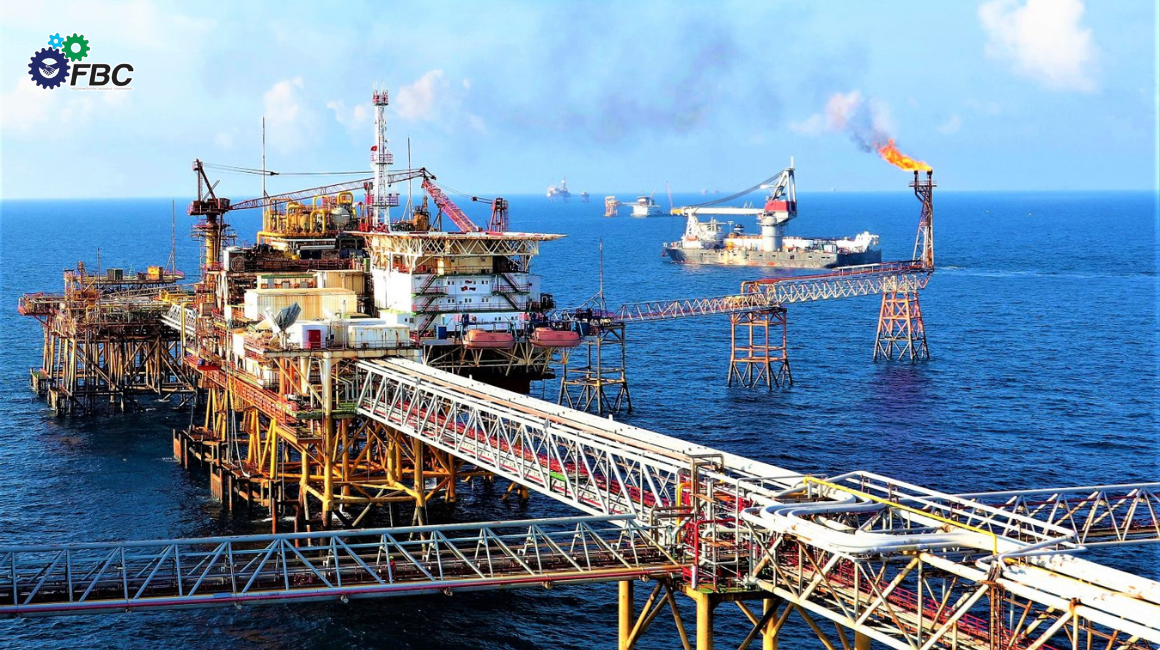
Vietnam’s imports are input driven, meaning they are purchased to fuel domestic production and future exports. As essential for the modernization and automation of factories, petroleum has become the primary energy source for industrial logistics and transportation.
Trade surplus and deficit
The trade balance reflects the difference between a nation’s export and import values. A Trade Surplus occurs when exports exceed imports, allowing a country to accumulate foreign currency reserves and strengthen its currency.
For instance, Vietnam has maintained an average annual surplus of $11 billion over the past five years, showcasing its robust export-led economy. Conversely, a Trade Deficit happens when imports surpass exports, often requiring foreign investment to bridge the gap.
Factors affecting International Trade
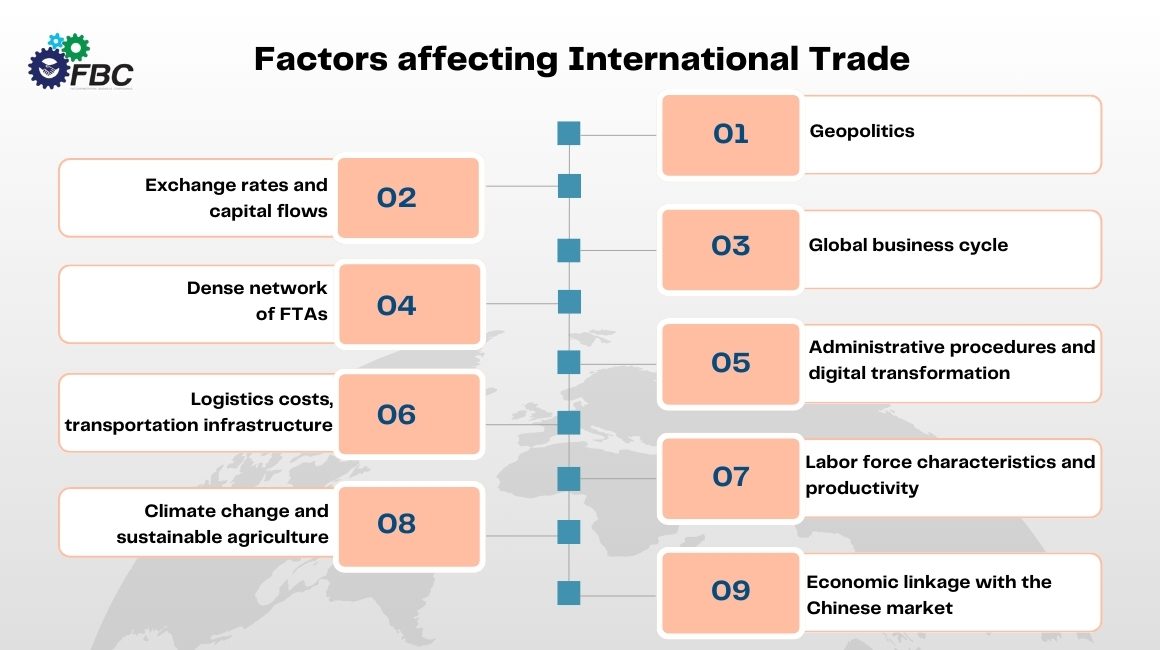
The flow of global commerce is not random; it is shaped by a complex set of key factors that determine how and why nations exchange goods.
- Geopolitics
Political relationships shape trade through policies, agreements, and tensions. Recent impacts include U.S.-China trade war (tariffs on $500+ billion trade), Russia sanctions (disrupted $300 billion flows), and regional blocs like ASEAN and EU creating preferential arrangements.
- Exchange rates and capital flows
Currency valuations directly impact export competitiveness. The U.S. dollar’s 15% appreciation (2022) reduced American export competitiveness. Vietnam attracted $36 billion FDI (2024) supporting industrial development.
- Global business cycle
Trade volumes expand 1.5-2x faster than GDP during growth but contract more severely in recessions. The 2020 pandemic caused 8.9% global trade decline vs. 3.1% GDP contraction.
- Dense network of FTAs
According to the Official Gazette of the European Union (L 186/2020), the EVFTA eliminates 99% of tariffs over 10 years: “The Union shall progressively eliminate customs duties on imports of goods originating in Vietnam” (Article 2.5)
- Administrative procedures and digital transformation
According to Decision No. 2212/QD-TTg dated December 10, 2020, Vietnam’s National Single Window system integrates customs, quarantine, and port authorities into unified electronic platform.
- Logistics costs and transportation infrastructure
Container shipping rates Asia-Europe/North America increased 300-500% (2021-2022), then declined 70% (2023-2024). Vietnam’s major ports (Hai Phong, Ho Chi Minh City, Cai Mep) rank among Asia’s top 50. Infrastructure investment: $15-20 billion annually.
- Labor force characteristics and productivity
Vietnam’s manufacturing sector maintains a strong competitive edge through its optimized balance of cost and productivity. With average manufacturing wages ranging from $300 to $350 per month, Vietnam offers a significant cost advantage compared to China’s $650–$800.
- Climate change and sustainable agriculture
EU Carbon Border Adjustment Mechanism (CBAM): Under Regulation (EU) 2023/956, CBAM imposes costs on carbon-intensive imports (steel, cement, aluminum) from October 2023. Green technology trade: $1.9 trillion globally (2024), growing 12% annually.
- Economic linkage with the Chinese market
Vietnam imports $115 billion from China (32% of total imports). ASEAN-China exports: $476 billion (2024). “China+1” strategy drives production relocation, with Vietnam capturing significant electronics and textile manufacturing.
Differences between domestic and International Trade
| Aspect | Domestic Trade | International Trade |
| Regulations | Single country rules | Multiple customs procedures, licenses |
| Currency | One currency | Exchange rate risks, conversion costs |
| Transportation | Shorter distances | Ocean/air freight, longer transit |
| Legal framework | One legal system | Multiple jurisdictions |
| Documentation | Simple invoices | Commercial invoices, certificates of origin, bills of lading |
| Payment | Standard terms | Letters of credit, trade finance |
| Standards | Domestic requirements | Importing country safety, environmental, labeling standards |
International Trade logistics: The backbone of global transactions
Logistics and finance serve as the essential infrastructure for global exchange, ensuring the physical and legal movement of goods. Ocean shipping remains the backbone of trade, carrying 80% of global volume, while air cargo handles 35% of trade value for time-sensitive products. Finally, trade finance mechanisms like Letters of Credit (UCP 600) mitigate risk by guaranteeing payments to exporters and ensuring delivery for importers.
Vietnam as a Strategic Manufacturing Hub for International Buyers
In the current 2026 landscape, Vietnam has evolved from a low-cost production base into a high-value, sustainable manufacturing hub, offering international buyers a strategic sanctuary amidst global supply chain volatility.
- Competitive Edge: Optimal labor costs ($300-350) combined with a high-quality workforce (500k technical graduates/year) provide a 30-40% cost advantage over China.
- Market Access: A powerful FTA network (EVFTA, CPTPP, RCEP) eliminates up to 99% of tariffs, granting preferential access to 30% of global GDP.
- Production Ecosystem: Strong local integration in electronics (40%) and textiles (80%), supported by 300+ industrial zones and stable energy costs.
- Regulatory & Risks: Streamlined 5-day investment registration (Decree 35/2022) and multi-port strategies help mitigate logistics and supply chain risks.
Frequently asked questions about International Trade
1. How is comparative advantage different from absolute advantage?
Absolute advantage focuses on producing more goods with the same resources, while comparative advantage focuses on producing goods at a lower opportunity cost relative to other products.
2. What does International Trade logistics include?
It involves the end-to-end management of moving goods across borders, specifically transportation (sea, air, or land), warehousing, and customs clearance. It also covers mandatory documentation, cargo insurance, and regulatory compliance to ensure smooth delivery.
3. How can businesses begin to participate in International Trade?
Businesses typically start by conducting market research to identify global demand and ensuring their products meet international regulatory standards. Participation can then begin through direct exporting, using global e-commerce platforms, or partnering with foreign distributors to manage local sales.
International trade generates prosperity through specialization, allowing countries to focus on their comparative advantage while accessing global markets. Success requires an understanding of economic theories, the ability to handle the complexities of logistics, and the building of reliable supplier relationships. For the latest news updates, follow the FBC ASEAN website today!
Ready to Expand Your Footprint in the Global Market? Struggling to Find Reliable Suppliers in Vietnam?
Stop wasting time on unverified leads and costly factory visits. FBC ASEAN connects you directly with 800+ manufacturers across mechanical engineering, automation, and supporting industries – all under one roof. Whether you need precision machining partners, OEM suppliers, or component manufacturers, FBC ASEAN delivers real sourcing opportunities with verified capabilities.
👉 Register as a buyer: